We tend to romanticize the pioneers.
In the popular imagination they arrive on the frontier fully formed, capable of everything, afraid of nothing. They fell trees, raise cabins, plant crops, and within a season or two have carved a prosperous farm from the wilderness. The reality was considerably more complicated, more difficult, and more interesting than the myth suggests.
Building a township on the Ohio frontier in the early 19th century was a collective undertaking that required years of grinding labor, careful legal navigation, community cooperation, and a willingness to absorb losses that would break most people today. The men and women who did it were not superhuman. They were ordinary people doing extraordinary things because they had no other choice.
This is what it actually took.
Getting There
Before a settler could build anything they had to get to their land, and getting there was itself a significant undertaking.
The Ohio frontier of the early 19th century was not served by roads in any meaningful sense. There were established routes connecting the larger settlements, and in some areas military roads built during the War of 1812 provided a rough corridor of travel. But beyond those main arteries the landscape was largely untracked forest, crossed by streams that had no bridges and paths that existed only because someone had walked them before.
A family relocating to the Ohio frontier typically traveled by wagon, which meant they were limited to whatever tracks and roads existed. In many parts of Ohio in the 1820s and 1830s that meant following stream corridors, navigating around wetlands, and in some cases simply cutting their own path through the forest to reach their land.
The load a family could carry was both everything they owned and a carefully calculated selection of what they would need to survive. Tools were essential and heavy. A broadaxe, a felling axe, a hoe, a plow if they could manage it. Seed corn and other food crops. Cookware and bedding. Whatever livestock they could drive on foot alongside the wagon. Children rode when there was room and walked when there was not.
The journey from an established Ohio county to the frontier edge of the state could take days or weeks depending on the distance and the condition of the ground. Spring travel meant mud that could swallow a wagon wheel to the axle. Fall travel meant better ground but a shrinking window before winter closed in. Timing mattered enormously and experienced settlers knew it.
Claiming the Land
Arriving at your land was not the end of the legal process, it was often the beginning of it.
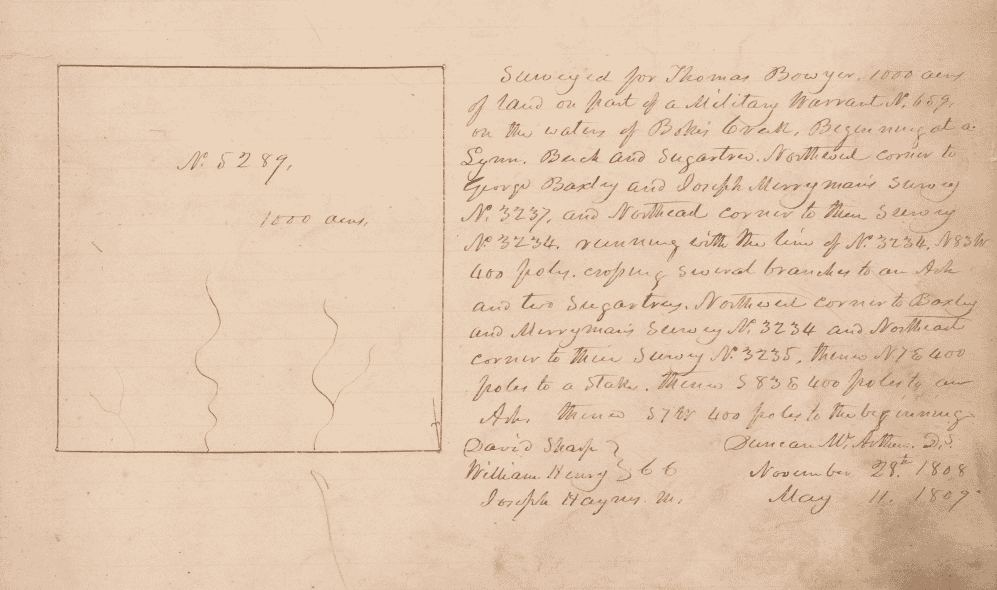
In the Virginia Military District, land was distributed through the warrant system. A settler who had purchased a warrant needed to have the specific tract surveyed before they could establish a clear legal claim. That meant locating a licensed surveyor, which in the early years of Ohio settlement could mean waiting months for one to be available, paying the survey fee, and then waiting again for the survey to be recorded with the appropriate authorities.
In other parts of Ohio, land was purchased directly from the federal government through land offices established at Chillicothe, Zanesville, and other locations. A buyer had to appear in person, select their tract from the available plats, pay the purchase price, and receive a certificate of entry. The actual patent confirming ownership might not arrive for years after the initial purchase.
During the gap between arrival and legal confirmation of title, settlers were often living on land they did not yet formally own. This created uncertainty that could last for years and in some cases produced disputes that ended up in court long after the original settler was dead.
The paperwork of the frontier was as challenging as the physical labor, and the men and women who navigated it successfully were not just hardy pioneers. They were people who understood legal systems, could read and write well enough to manage their own affairs, and had the patience to work through a bureaucratic process while simultaneously trying to keep their families fed.
Building the Cabin
The first structure on a new claim was almost always a log cabin, and building it was typically the first major communal event of a new settlement.
A single family could not raise a log cabin alone. The logs were too heavy, the work too demanding, the time too short. Neighbors, however distant, were called upon for help. A cabin raising was a social event as much as a construction project, bringing together every able-bodied person within a reasonable distance for a day or two of concentrated collective labor.
The logs had to be felled, limbed, and hauled to the building site before the raising could begin. This work fell to the family themselves in the weeks or months before neighbors arrived. Trees were selected for straightness and size, felled with a broadaxe, trimmed, and sometimes hewn flat on two or four sides depending on the builder’s skill and the intended quality of the structure.
The corner notching that held the logs together was skilled work. A well-cut half-dovetail notch locked the logs together against outward pressure and shed water away from the joint. A poorly cut notch left gaps that let in wind, water, and cold. The quality of the notching was a direct measure of the builder’s skill and experience, and a well-notched cabin was a source of genuine pride.
Roofing, chinking, flooring, and the construction of a fireplace or the installation of a stove followed the raising itself. A family might be living in a partially finished cabin for months before it was truly weathertight. The first winter in a new cabin on the Ohio frontier was a test of endurance that many families remembered for the rest of their lives.
Feeding Yourself
The first year on a new claim was the most dangerous from a food security standpoint.
A family that arrived in the spring had a single growing season to establish enough food production to carry them through the winter. That meant clearing enough forest to plant a crop, which meant felling trees, pulling stumps, and breaking ground that had never been plowed, all while simultaneously building a shelter and managing whatever livestock they had brought with them.
The standard first crop on the Ohio frontier was corn. Corn could be planted in rough ground between stumps without full plowing. It grew quickly, produced abundantly in good conditions, and could be stored through the winter. A family that made a good corn crop in their first season had a fighting chance. A family that lost their crop to drought, flood, or frost faced a very different prospect.
Wild game supplemented the diet significantly in the early years of settlement. Deer, turkey, and smaller animals were abundant in the forest and an experienced hunter could keep a family in protein through the lean months. But hunting took time away from the clearing and planting and building that also had to be done, and the balance between immediate food needs and long-term farm establishment was a constant tension in the first years.
Neighbors shared what they could. The communities that formed on the Ohio frontier were bound together partly by genuine affection and shared values and partly by the hard practical reality that survival in the first years often depended on the generosity of the people around you. A family that arrived with nothing to spare might receive seed corn on credit from a neighbor, repaid from the first harvest. A family whose crops failed might be fed through the winter by the community around them.
That mutual dependence was the foundation of township life.
Building a Community
A collection of farms is not a community. What turned the Ohio frontier settlements into functioning communities was the establishment of the institutions that gave them civic and social shape.
The first of these was almost always a church. Religious life on the Ohio frontier was central in a way that is difficult to fully appreciate today. The church was not just a place of worship. It was the primary social institution of the community, the place where people gathered regularly, where marriages and deaths were marked, where disputes were sometimes mediated, and where the shared values of the settlement found their public expression.
Early frontier churches often began without a building at all. Congregations gathered in cabins, in barns, or outdoors. A circuit-riding preacher might visit once a month or less, and in his absence the congregation maintained itself through lay leadership and private devotion. The construction of a proper meetinghouse was a community milestone, requiring collective labor and donated materials, and its dedication was celebrated accordingly.
Township government followed a similar pattern. Under Ohio law a township could be organized once sufficient settlement had occurred, and the first township election was a significant civic occasion. Officers were elected to manage the practical affairs of the community. Trustees oversaw township business. Fence Viewers adjudicated property boundary disputes. Overseers of the Poor managed assistance to community members in need. Road Supervisors organized the collective labor that maintained the township’s roads.
These were not ceremonial positions. They were working roles that required time, judgment, and the trust of the community. The men elected to them in the first township elections were the acknowledged leaders of the settlement, the people their neighbors trusted to manage the affairs of the community fairly and competently.
Schools came later, typically after the immediate demands of survival had been met and families had enough stability to think about the education of their children. Early frontier schools were often subscription schools, funded by the families whose children attended, held in whatever building was available, and taught by whoever in the community had sufficient education to serve as a teacher. The quality varied enormously but the commitment to education was genuine and widespread across the Ohio frontier.
What It Cost
Not everyone who came to the Ohio frontier succeeded.
The historical record of any early township includes the families who arrived, struggled, and left. Some were defeated by crop failures. Some by illness. Some by the simple miscalculation of what the frontier actually demanded. Some arrived too late in the season, or with too little capital, or with livestock that died on the journey west. Some survived the first year only to be broken by the second or the third.
The survivors remembered the ones who didn’t make it. The obituaries and memoirs and family histories of the Ohio frontier are full of references to neighbors who gave up and went back east, or who pushed further west looking for easier ground, or who simply disappeared from the record without explanation.
Those who stayed and succeeded did so through a combination of skill, luck, community support, and a stubbornness that the historical record can document but not fully explain. They were not superhuman. They were people who decided, for whatever reason, that this was the place they were going to make their lives, and who kept making that decision through every difficulty the frontier threw at them.
The townships they built are still here. The county courthouses still hold the deed records and probate files and election returns that document what they did. The landscape they cleared and farmed and organized into communities is the landscape we live in today.
That is the history we are committed to finding and telling. Not the myth of the pioneer, but the reality. The mud and the labor and the crop failures and the cabin raisings and the first church services held in someone’s front room and the first township elections and the gradual, difficult, collective process of turning a wilderness into a place people could call home.