Little Turtle and the Wars for Ohio
Before Ohio was Ohio, it had to be fought for.
That sentence is true in more than one direction. The story of the wars that preceded the Treaty of Greenville is not a simple story of American expansion overcoming Native resistance. It is a story of nations with legitimate competing claims to the same landscape, of military campaigns that went catastrophically wrong, of leaders on both sides who understood more clearly than history has sometimes credited them what was actually at stake, and of a final reckoning that shaped the destiny of an entire region for the next two centuries.
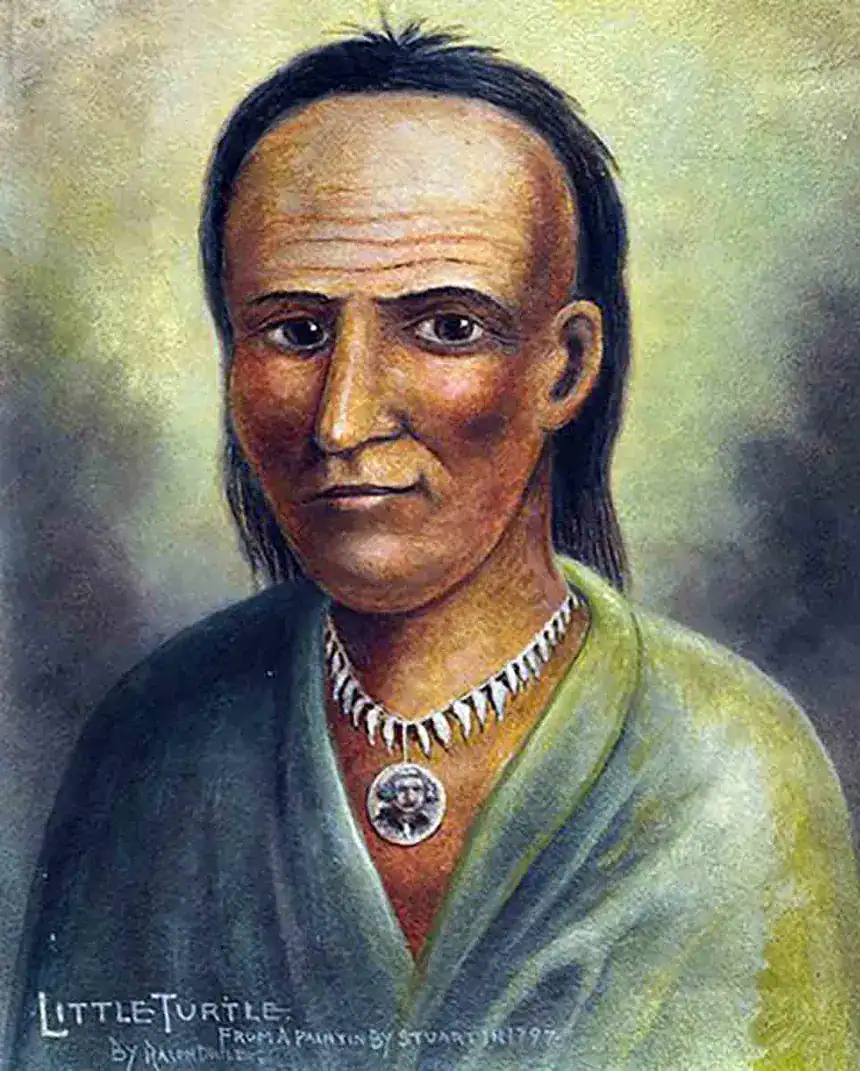
At the center of that story stands a Miami war chief named Michikinikwa. History remembers him as Little Turtle. He was one of the most gifted military commanders the North American continent has ever produced, and for a brief period in the early 1790s he came closer than anyone before or since to stopping American westward expansion in its tracks.
The World Little Turtle Was Born Into
Little Turtle was born around 1747 in what is now northeastern Indiana, near the headwaters of the Maumee River. He was the son of a Miami chief and a woman of Mahican descent, and he grew up in a world that was already being profoundly disrupted by the competition between European colonial powers for control of the North American interior.
The Miami were one of the dominant nations of the Great Lakes and Ohio Valley region. They were skilled farmers, traders, and diplomats who had maintained their position through a combination of military strength and political intelligence. They understood the dynamics of colonial competition and had learned to navigate the competing interests of the French, the British, and eventually the Americans with considerable sophistication.
By the time Little Turtle came to prominence as a military leader in the 1780s the world of his childhood had already changed dramatically. The British had defeated the French in the Seven Years War, eliminating one of the Native nations’ most useful counterweights to British power. The American Revolution had produced a new nation with an aggressive appetite for western land. And the Treaty of Paris in 1783, which ended the Revolution, had transferred British claims to the Northwest Territory to the United States without any consultation with the Native nations who actually lived there.
Those nations had not agreed to anything. They had not been defeated. And they had no intention of simply stepping aside.
The Confederation
The resistance to American expansion in the Ohio country was not the work of a single nation acting alone. It was a confederacy of nations that included the Miami, Shawnee, Delaware, Wyandot, Ottawa, Ojibwe, Potawatomi, and others, bound together by the shared understanding that American settlement in the Northwest Territory posed an existential threat to all of them.
This confederacy was not always unified. The nations within it had their own histories, their own rivalries, their own internal politics, and their own assessments of how best to respond to American pressure. Maintaining collective action among nations with different interests and different traditions of decision-making was itself a significant political achievement, and the leaders who managed it deserve more credit than they typically receive in American historical accounts.
Little Turtle emerged as the most capable military mind within this confederacy. He was not the overall political leader of the alliance, but when it came to planning and executing military operations against American forces he was without peer. His approach was characterized by careful intelligence gathering, precise timing, exploitation of terrain, and an ability to coordinate the movements of warriors from multiple nations against a common objective.
Those qualities would soon be tested against the full military force of the United States.
St. Clair’s Defeat
The American government’s approach to the Northwest Territory in the late 1780s and early 1790s was straightforward in its intention if catastrophic in its execution. The territory had been organized under the Northwest Ordinance of 1787. Surveys were underway. Settlers were moving in. The Native nations needed to be removed or subdued, and the United States Army was the instrument chosen for that purpose.
Two early American military expeditions into the Ohio country in 1790 and 1791 produced mixed results. The second of these, under General Josiah Harmar, was repulsed with significant losses. The response in Philadelphia, where the federal government was then seated, was to authorize a larger and more decisive campaign.
General Arthur St. Clair was given command of an army of nearly 1,400 men and ordered to march into the heart of Native territory and establish a permanent American military presence. St. Clair was a veteran of the Revolution and a man of considerable political standing. He was not, as events would demonstrate, a military commander equal to the task he had been given.
Little Turtle watched the American army move north through Ohio in the fall of 1791 and saw its weaknesses clearly. The force was poorly supplied, inadequately trained, and moving slowly through unfamiliar terrain. Discipline was inconsistent. Desertion was a constant problem. The army made camp on the night of November 3rd near the headwaters of the Wabash River in what is now northwestern Ohio, in a position that Little Turtle recognized immediately as vulnerable.
Before dawn on November 4, 1791, the confederacy struck.
What followed was the most complete military disaster in the history of the United States Army. Little Turtle’s warriors, numbering somewhere between 1,000 and 1,500, attacked from multiple directions simultaneously in the pre-dawn darkness. The American force disintegrated almost immediately. Soldiers who attempted to form defensive lines were flanked and overwhelmed. Officers trying to rally their men were cut down. The camp became a killing ground.
When it was over, more than 600 American soldiers were dead and another 300 wounded out of a force of fewer than 1,400. St. Clair himself barely escaped. It remains to this day the single worst defeat ever inflicted on the United States Army by Native American forces, measured by the percentage of the force killed. More Americans died on that field in a single morning than in any battle of the Revolution.
The news reached Philadelphia like a thunderclap. President Washington, who had commanded armies through eight years of revolutionary war, was reported to have been reduced to furious despair when he learned what had happened. The response was immediate and determined. A new army would be raised, better trained, better supplied, and better led. The United States was not going to accept what had happened on the Wabash as a final answer.
Anthony Wayne and the Road to Fallen Timbers
The man chosen to command the new American army was General Anthony Wayne, known during the Revolution by the nickname Mad Anthony for his aggressive battlefield style. Wayne was everything St. Clair was not as a military commander. He was methodical, demanding, and obsessively attentive to training and discipline. He spent two years rebuilding the American force into what he called the Legion of the United States before he was satisfied that it was ready to march.
Little Turtle watched this preparation with a clear eye. He understood what a well-trained and well-supplied American army represented and he counseled the confederacy accordingly. The Americans they had defeated under Harmar and St. Clair were not representative of what the United States could field if it was truly determined. The force Wayne was building was different in kind, not just degree. Little Turtle argued for negotiation, for using the military victories already achieved as leverage to secure a favorable treaty rather than risking everything in a battle against a force that might not be beatable.
His counsel was not followed. Other leaders within the confederacy, encouraged by British agents who promised support that never fully materialized, argued for continued resistance. Little Turtle stepped back from overall military command, though he continued to fight alongside his people.
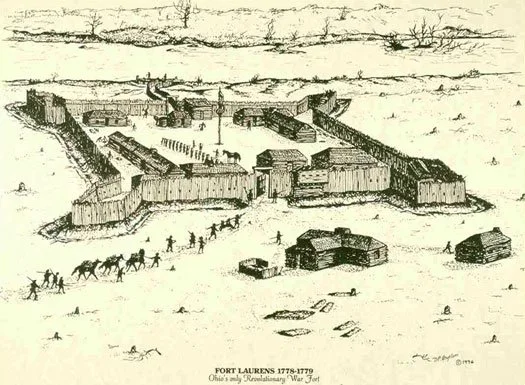
The two armies met on August 20, 1794, at a place along the Maumee River in northwestern Ohio where a recent tornado had toppled hundreds of trees, creating a broken landscape of fallen timber that gave the battle its name. Wayne’s Legion attacked in disciplined formations, bayonets fixed, driving through the confederacy’s defensive position before the warriors could fall back to the cover of the British fort nearby. The British, unwilling to risk open war with the United States, closed their gates and left their Native allies to face the Americans alone.
The Battle of Fallen Timbers lasted less than an hour. It was not a massacre. Casualties on both sides were relatively light by the standards of 18th century warfare. But its consequences were total. The confederacy that had humiliated two American armies and held American expansion at bay for nearly a decade was broken as a military force. The British alliance that had sustained Native resistance evaporated. And the path to a negotiated settlement, on American terms, was now open.
The Treaty and Its Aftermath
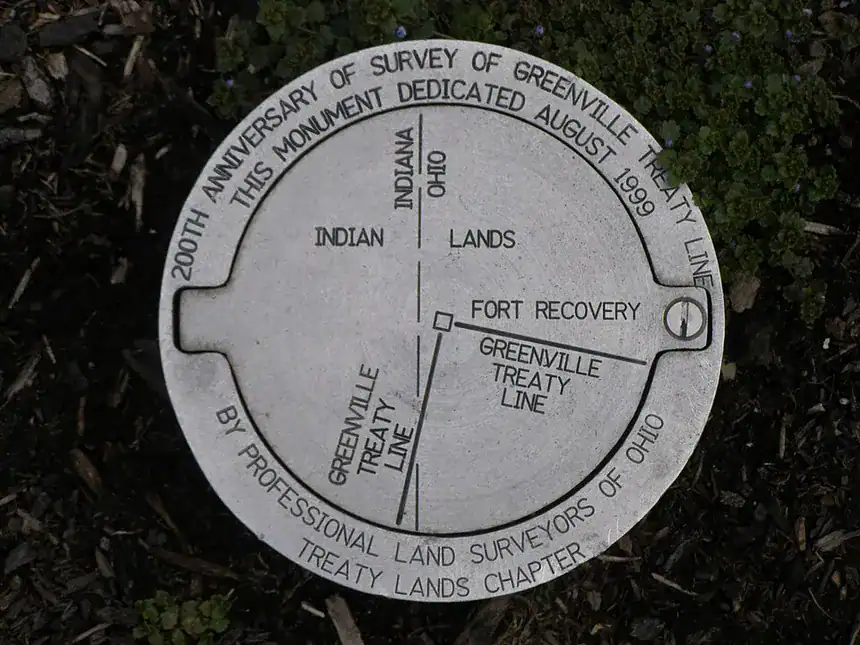
Little Turtle was among the Native leaders who came to Greenville in the summer of 1795 to negotiate with General Wayne. He signed the Treaty of Greenville on August 3rd, ceding the territory that would become most of Ohio to the United States.
His speech at Greenville was remarkable for its honesty and its dignity. He acknowledged the military reality without self-pity and asked only that the United States honor its treaty commitments faithfully. He spent the remaining years of his life, he died in 1812, working to find a path forward for his people within the new reality the treaty had created. He visited Philadelphia, met with President Washington and later President Adams and Jefferson, and attempted to negotiate an accommodation that would allow the Miami and their neighbors to survive as distinct peoples.
History has not always been kind to leaders who chose accommodation over continued resistance, and Little Turtle’s later reputation has sometimes suffered for the path he chose after Fallen Timbers. But the military record of the years before that battle speaks for itself. For nearly a decade he led a confederacy of nations against the full military power of the United States and won, repeatedly and decisively, until the combination of a reformed American army and British abandonment made further resistance untenable.
Why This History Matters
The wars for Ohio are not a prelude to the real history of the state. They are central to it.
Every farm established on the Ohio frontier after 1795, every township organized, every cabin built on a Virginia Military warrant tract, every church founded in someone’s front room in the early decades of the 19th century, existed in a landscape shaped by what happened at the Wabash in 1791 and at Fallen Timbers in 1794 and at Greenville in 1795. The settlers who came west after the treaty were moving into territory that had been contested, fought over, and finally ceded at enormous cost by the people who had lived there before them.
Understanding that context does not diminish the achievement of the men and women who built Ohio from the frontier. It deepens it. It places their story in its full human complexity, acknowledging both what was gained and what was lost in the making of this state.
That is the history the Ohio Frontier History Center is committed to telling. Not a simplified story of inevitable progress, but the full complicated truth of what happened on this land between 1750 and 1850, told with honesty and respect for everyone whose story it was.
Little Turtle deserves to be part of that telling. So do the thousands of unnamed warriors who fought alongside him, the families who were displaced by the treaty he signed, and the nations who lost a homeland in the making of an American state.
Their story is Ohio’s story too.