
The Ohio Frontier History Center The Coons Settlement
The Coons Settlement
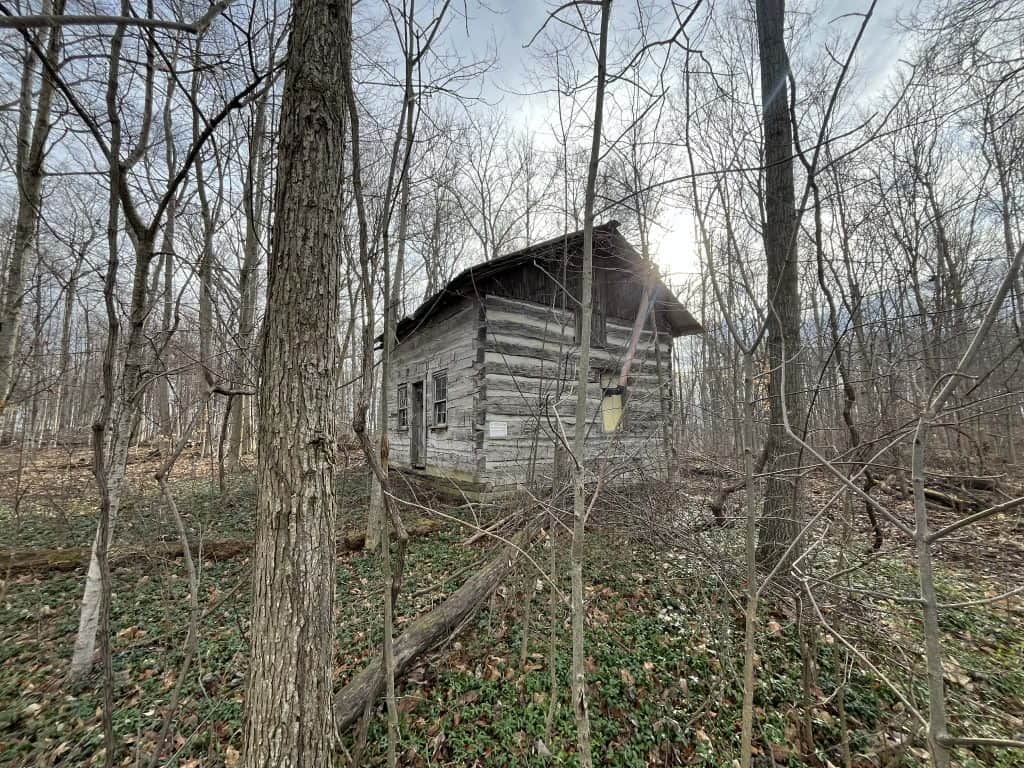
In the fall of 1829, a man named George Coons came alone into the wilderness of north-central Ohio and built a cabin. He was the third settler in York Township, Union County. He cut the roads to his land himself.
That cabin is still standing.
It sits on 1.69 wooded acres on State Route 739 outside Richwood, Ohio, a small island of old-growth hardwoods surrounded on all sides by industrial solar installations. The logs are hand-hewn. The corner notching is half-dovetail, the work of a skilled builder working in an established Pennsylvania tradition. The original shake roof survives beneath a later metal overlay. The cabin has stood for nearly two hundred years and is still structurally sound.
This is the founding homestead of Coons Settlement, one of the three earliest communities in York Township, and it is the last surviving physical remnant of that world. Every other structure, every other parcel of land that once made up this community, is gone. The cabin is all that remains.
Our Vision
History is best understood when you can experience it directly, so The Ohio Frontier History Center is working to acquire, restore, and interpret Coons Settlement as a living history homestead and working farm.
We intend to restore this 1829 cabin to its historic appearance, reconstruct the original porch from surviving physical evidence in the structure itself, and establish a full complement of frontier-era outbuildings to include a summer kitchen, root cellar, springhouse, sugar shack, and log barn built from timber harvested on the property.
The land will be worked as it was in the early 19th century, with a market garden, heritage orchard, maple sugaring operation, and heritage livestock.
Visitors will experience the site through first person living history interpretation. When you come to Coons Settlement you will not watch history from behind a velvet rope; you will step into it. You will smell woodsmoke from the summer kitchen. You will hear the sound of the broadaxe and the adze. You will walk the same ground that George Coons walked when he arrived here in the fall of 1829 with nothing but a wagon load of supplies and a determination to build something that would last.
We are also pursuing a National Register of Historic Places nomination for the property, recognizing its significance as one of the earliest surviving structures in York Township and its association with the Revolutionary War land grant system, the civic and religious founding of the township, and the Civil War service of George W. Coons.
Coons Settlement will serve as a site for school field trips, public living history programs, genealogical research, agricultural workshops, and seasonal events tied to the rhythms of the 19th century farm calendar. It will be a place where the Ohio frontier is not a distant abstraction, but a living, breathing, working reality.
How You Can Help
The current owner of this cabin has agreed to hold the property while we assemble the funding to save it. But that window will not stay open indefinitely.
We are raising funds to acquire the property and begin the restoration process. Every dollar raised goes directly toward securing this irreplaceable piece of Ohio history before it is lost.
If you believe that places like this matter, that the stories of the people who built Ohio from the wilderness deserve to be told and remembered and experienced rather than forgotten, we are asking for your support.
Donate. Share. Tell someone about this place.
The cabin has been standing for nearly two hundred years. With your help it will stand for two hundred more.
The History
The land beneath the cabin has a history that reaches back further than George Coons. The property sits on the Greenville Treaty Line of 1795, the boundary established between the United States and twelve Native American nations following the Battle of Fallen Timbers. It lies within Virginia Military Survey No. 5289, a tract surveyed in 1808 by Duncan McArthur, who would later serve as Governor of Ohio, on land granted to Thomas Bowyer in payment for his service in the 12th Virginia Regiment during the Revolutionary War.
George Coons purchased the 100-acre tract and arrived in the fall of 1829. He built the cabin that fall, spent the winter hauling wagon loads of supplies from Fairfield County, and brought his family to their new home on April 1, 1830. He cut the only road to his property himself.
What he built here was more than a farm.
On June 29, 1839, thirteen people gathered in this cabin and founded the York Township Free-Will Baptist Church. George and his wife Keziah were among the founding members. The congregation that began in that room became one of the anchors of the community for generations.
George served as Fence Viewer in the first York Township election on April 7, 1834, and was one of the civic founders of the township itself. He died on this farm in October 1856 at the age of 78, having spent 27 years building something from nothing in the Ohio wilderness.
His family kept building after him.
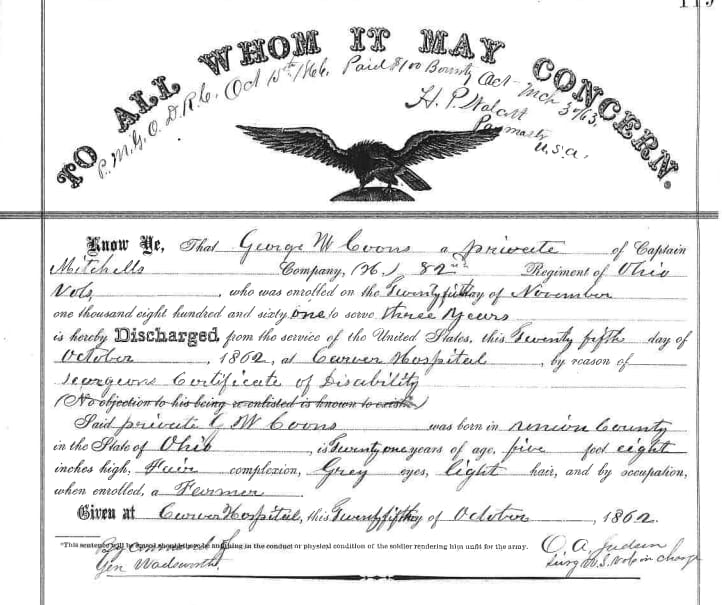
George’s grandson George W. Coons enlisted in the 82nd Ohio Volunteer Infantry in November 1861, going off to war from this farm. At the Second Battle of Bull Run he was wounded, had his left leg amputated on the battlefield, and was taken prisoner by Confederate forces. He was left without food for eight days. He washed and bandaged his own wounds in the field, and managed to survive. After returning home, he farmed for another fifty years on one leg.
The Coons family held this land for 149 years, from George’s arrival in 1829 until 1978. Six generations on one piece of ground. Today the cabin sits vacant, its history unknown to nearly everyone who passes it on SR 739, surrounded by solar panels where the fields and farms of Coons Settlement once stretched in every direction.