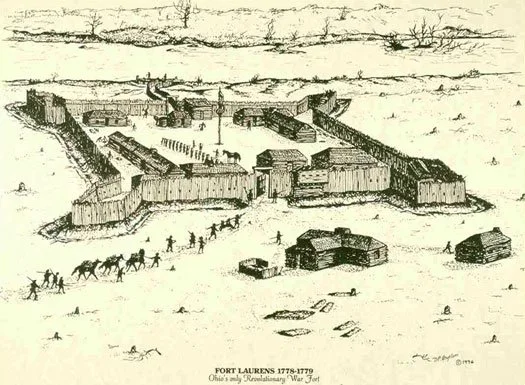
Most people think of the American Revolution as an eastern war. Lexington and Concord. Valley Forge. Yorktown. The battles that shaped the nation’s founding mythology all happened east of the Appalachians, in places that had roads, supply lines, and at least a reasonable chance of reinforcement.
Ohio was not that kind of place.
In the fall of 1778, Brigadier General Lachlan McIntosh led a force of roughly 1,200 Continental soldiers and militia out of Pittsburgh and into the Ohio Country. The goal was ambitious: push deep into the wilderness, establish a forward base, and eventually strike the British garrison at Fort Detroit. It was the kind of plan that looked reasonable on a map and fell apart on the ground.
By the time McIntosh reached the Tuscarawas River in late November, it was already too cold, the supply line behind him had collapsed, and Detroit was still hundreds of miles away. The invasion was over before it started. McIntosh made a decision that would define the next nine months for the men under his command: he ordered the construction of a fort on the west bank of the Tuscarawas, left a garrison of roughly 150 men to hold it through the winter, and marched the bulk of his force back to Pittsburgh.
The fort was named Fort Laurens, after Henry Laurens, president of the Second Continental Congress. It was the only American military fortification built within what is now the state of Ohio during the Revolutionary War. It was also, almost immediately, a trap.
Isolated and Hungry
Colonel John Gibson of the 13th Virginia Regiment was left in command with 19 officers and around 150 enlisted men. The fort itself was a standard four-sided stockade with a blockhouse, built quickly from whatever timber was available. It sat on the edge of the known world as far as the Continental Army was concerned — too far from Pittsburgh to be reliably supplied, too far from Detroit to threaten anyone, and deep in territory where the British and their Native allies moved freely.
The British learned of the fort almost immediately. Simon Girty, an American-born frontier scout who had cast his lot with the British and maintained strong ties to the Native nations of the Ohio Country, arrived outside Fort Laurens in January 1779 with a party of Mingo warriors. He had missed a small resupply column that reached the fort just before him, but he ambushed the escort on its return trip to Pittsburgh. Two Americans were killed, four wounded, and one taken prisoner.
Those prisoners told Girty what conditions were like inside the fort. They were not good.
By mid-February, the garrison was starving. A party of 19 men sent out to cut firewood on February 23rd was attacked within sight of the fort’s walls. Most were killed. Two were captured. Then the siege began in earnest.
The Siege
A force composed primarily of Wyandot and Mingo warriors, operating in coordination with British officers including Colonel Henry Bird, surrounded Fort Laurens and cut it off completely. Estimates of the besieging force ranged from 180 to over 800 — the men inside the walls had no way of knowing for certain. What they knew was that they could not get out.
Captain Benjamin Biggs of the 13th Virginia later recalled what those weeks were like. The siege lasted four weeks. Provisions ran out. For three or four days the garrison subsisted on half a biscuit each per day. Then, in the final days, they boiled and ate their moccasins and strips of old dried hide.
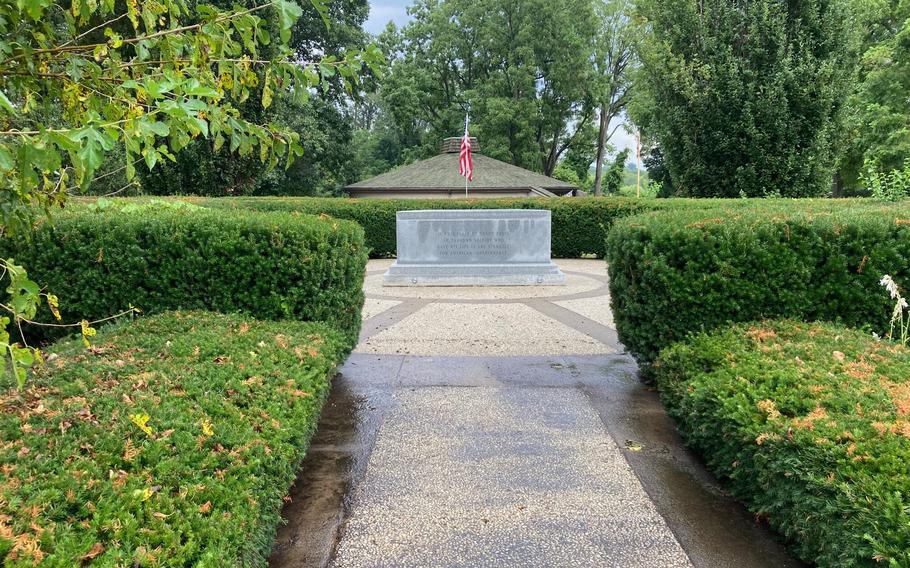
Relief came just in time. American reinforcements finally approached from the east, and the besieging force withdrew rather than risk open battle. The garrison had held, but barely. Twenty-one soldiers died at Fort Laurens before it was abandoned. Several of them were killed in the February 23rd attack, their remains later recovered from a mass grave during archaeological excavations in the 1980s. One of those soldiers, whose identity could not be determined, was interred at the site in what became the Tomb of the Unknown Patriot of the American Revolution.
Abandoned
Colonel Daniel Brodhead, who had replaced McIntosh in command of the Western Department, recognized what McIntosh had perhaps always known: Fort Laurens made no strategic sense. It was too far from its objective and too difficult to supply. In August 1779, he ordered it abandoned. The garrison burned what they could and marched east. The fort had existed for less than a year.
The site was eventually absorbed by farmland. When the Ohio and Erie Canal came through in the 1830s, it destroyed what little remained of the eastern wall. By the time anyone thought to preserve the site, there was almost nothing left to preserve.
What Remains
Fort Laurens was added to the National Register of Historic Places in 1971. Archaeological excavations in the early 1970s established the fort’s actual location — about 200 feet south of where it had been assumed to be — and traced the outline of the stockade walls. The artifacts recovered from those digs, along with the remains of the soldiers, are now part of the site’s small museum near Bolivar in Tuscarawas County.
The Ohio and Erie Canal Towpath Trail, a recreational trail stretching more than 80 miles, now runs through the site. The outline of the fort is visible on the ground. The Tomb of the Unknown Patriot stands as a quiet reminder that the Revolution was fought here too, in the Ohio wilderness, by men who were cold and hungry and a long way from home.
As the United States approaches its 250th anniversary, there are ongoing efforts to reconstruct a portion of the fort, giving visitors a physical sense of what McIntosh’s men built and held through that terrible winter.
Fort Laurens lasted nine months. It achieved almost none of its strategic objectives. And it remains the only place in Ohio where the Revolutionary War left a mark in the ground.